3. Robby de Backer tells the story of Chrisobal Colon (23-4-2009)
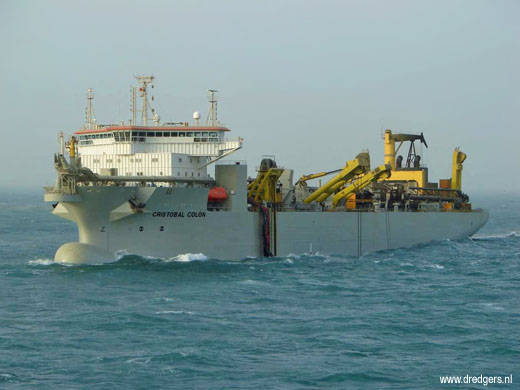
Fig 1. Cristobal Colón at sea trials (www.dredgers.nl)
Dredger Details
Technical details
| Home |
Technical details |
Job details |
No details |
More details |
My details |
3. Robby de Backer tells the story of Chrisobal Colon (23-4-2009)
Fig 1. Cristobal Colón at sea trials (www.dredgers.nl)
The usual details
Introduction
The CEDA has regular meetings and lectures to present the latest interesting developments of the dynamic world of dredging. One of the awe inspiring topics that are always good for an eager audience are the new buildings of the dredging company Jan de Nul of Belgium. The most gifted man to elaborate on this item, is their own Robby de Backer.

Fig 2. ir. Robby de Backer (www.dredging.orgl)
Currently Jan de Nul is building two giant mega jumbo hoppers in Spain. The first vessel is the Cristobal Colón, an enormous colossus of 46.000m³ hopper capacity. The Cristobal Colón and its sister ship Leiv Erikson are in a lonesome region of dredging technology only shared with the 'HAM 318' of van Oord and the 'Queen of the Netherlands' of Boskalis.
However, for this presentation Robby the Backer prefers to compare the Cristobal Colón with the Vasco da Gama, as up till now the Vasco da Gama was the standard with which everything at Jan de Nul (and in the rest of the dredging industry) was matched.
Main Dimensions
The exact dimensions are sure to be found somewhere on the internet and are published in various magazines. The main design parameter is that the Cristobal Colón has a hopper capacity of 46,000 m³, while the Vasco da Gama is one of 33.000m ³. This increase is primarily achieved from the length rather than the width. Off course the width is also increased for the stability requirements. As a result, the Cristobal Colón is now not fitting through the Panama Canal anymore. In itself not a problem since Jan de Nul is hard at work to make the channel fit for the Cristobal Colón.

Fig 3. General arrangement Cristobal Colón (www.theartofdredging.coml)
Jan de Nul has never had a problem with the deep draft in restricted projects and did not take really any limitations in the design considerations.
However, they really investigated in the speed of the vessel. This has a number of issues that had some influence on the design choices. They will be discussed later. The loaded draft is now 18 knots and empty even 20 knots. By comparison, the Vasco da Gama has not more than 16 knots.
Although the hopper is much larger, the two suction tubes are slightly smaller. It is assumed that the mixture concentration of the mixture is higher because of the submerged suction pump and that the loading times are the same if not better. In any case, they expect no vacuum problems, where Vasco da Gama sometimes has been plagued by.
The shore discharge system is not bigger than that of the Vasco da Gama. That depends that they have two of the largest available pumps placed. For additional discharge capacity would require that a larger pump must be designed or third has to be placed in line. This is a difficult exercise but that they refrained from doing so.
Normally the vessel will sail with a crew of 25 men aboard. There are provisions for 46 men on board in the accommodation, mainly because there is often a lot of supervision or a complement of local crew should be on board. The nautical staff is often Belgians or Dutch. The technical staff in engineering is also preferred to be Belgian or Dutch, but there are good experiences with people from various Eastern European countries. The deck crew are often Philippinian or from other Asian origin.
Hull Form
The choice for the submerged dredge pump gives a lot of freedom in the hull form. Because you are not tied to a particular configuration of the suction pipes inboard, they could put the slide rails as far as possible and desirable forward. The tubes are then on deck all the way to the aft ship. Those alone gives already the possibility of using pipes to a depth of 155 meters and accommodate them without trouble.
Furthermore, because of the submerged dredge pumps, there is a possibility of designing the engine room differently too. They have no need for suction pumps inboard and can save on the pump room. Therefore they had the freedom to design the hopper as long as possible. This in turn, was necessary because a concentrated weight of the load would otherwise create unacceptable high tensions in the structure. As the weight is now distributed as long as possible, the construction is also slightly lighter, which in turn benefits the payload.
Furthermore, a long ship sails at a higher speed naturally. Speed was an important requirement in this design. Such a large hopper is only feasible if the sailing speed is high enough to cary bring that amount of sand at its destination fast and return quickly. For example, the aft is even better swept than that of the Vasco da Gama. Now there is a genuine twin skeg stern designed, in which the drive shafts are integrated. No shafts in the water anymore and no suspended struts. However there is a central skeg at the bottom, but that is only needed for strength in the stern while docking. Otherwise, the unsupported length is so long that the overhanging stern would sag too much.

Fig 4. Cristobal Colón aft ship (www.dredging.org)
On the bow is an elegant bulbous bow design that is genuinely intended to improve the streamline. With the Vasco da Gama, it was mainly a trick to improve the trim, and when sailing empty, it only acted as waterline extension. Now at loaded ship, there is really a wave reduction and the streamlining of the empty vessel is also improved.

Fig 5. Bulbous bow of Cristobal Colón (www.theartofdredging.coml)
These hydrodynamic improvements are mainly achieved by improving the computing capabilities in the design stage. Early in the design stage, MARIN modelled the potential flow with viscous flow models, and there the most improvements already rolled out of the computer.
To prevent that the ship can sail it aground during discharging, the bottom doors of the Vasco da Gama are retracted. This is not very good for the streamline of the bottom. Therefore, the doors of the Cristobal Colón are in the plane of the bottom plates. This is much better for the streamline and reduces the resistance.

Fig 6. Computer calculations MARIN for Cristobal Colón (www.dredging.org)
The result is that the capacity per ship weight for the Cristobal Colón a lot less than for the Vasco da Gama. Additional advantage is that when they sail slightly slower with this fast hull shape, the fuel consumption decreases a lot and, therefore, sails at a very good economic speed.
Steel
For sailing at high speed and still carry as much cargo as possible, the ship has to be as light as possible. If you do not want to carry less load, you should carry less ship. The keep the ship strong enough, high tensile strength steels are applied at various places. There were long held doubts in the dredging industry whether this steel would resist the tough dredging conditions. Especially the corrosion properties were a concern. It was feared that if you can make a thinner plate with high strength steel and you lose a millimetre to rust, that this has more impact if you lose the same millimetre to a thicker plate of less strong steel. In the long prismatic section where the hopper is, this reduced a lot of weight; also due to the better load distribution over the length of the ship. Now it is a fact that higher tensile strength steel can be put under a tension, the elasticity is not different. At the same load, you have more elongation. Thus, you will have a weaker vessel. Especially in the areas where you have many foundations in the engine room and the fore ship it is undesirable, so you have to look carefully at the stiffness.
At the engine room and the fore ship, there is a double bottom over the full width of the ship as foundation for the machinery. However, this double bottom is 15 meters under water and the water on this area makes that the bottom is pushed inward and that you will have an unacceptable displacement on drive train. This was remedied by placing additional bulkheads in the engine room.
Where previously the design of the Vasco da Gama construction was designed in accordance with the rules of the classification society and then checked with a finite element package if there were not too many hot spots. Where at the Cristobal Colón the design started with the FEM calculation and the ship was constructed directly. Calculations show that if the ship is loaded, amidships will sag about 40cm.

Fig 7. FEM calculation of Cristobal Colón (www.dredging.org)
The biggest saving they did is by not designing the ship as Jack-of-all-trades. Previously they designed each ship as if it had to work everywhere. With these ships they stepped from that philosophy and have deliberately left a number of options out. If the project still needs a dredge that can do the job, what the Cristobal Colón cannot, that dredge will be brought in. The ships now under construction and at commissioning are actually designed as a fleet, with the functions of the various vessels complementing each other as they work together on a project. The installations and facilities that they don't need on one boat, because it is on the other saves a lot of weight on the first and can be used for extra sand now.
Machinery
Jan de Nul has finally arrived at the conclusion that electrical drives are the way to go. Did they claim for a long time that a gearbox was the simplest tool to converse power; they now turn to the frequency controllers. Robby made a small confession that they experienced in the Vasco da Gama slightly more problems with the gearbox than they actually wanted to admit.
The electrical drives has given them some freedom in the layout of the ship and where which installation can be placed. So they now have placed the discharge pumps (also because of the breadth of the ship) between the engines. This means that the engine room could be made extremely short, so that the hopper could get slightly more length.
They expect to have a load factor of 70% of the installed capacity. Fuel and capacities are in accordance to this.
Hopper
In comparison with the Vasco da Gama, which has six doors, the Cristobal Colón now has nine. Partly because it was of the frame arrangement that lend itself for three times three doors. On the other hand, it is a fact that these hoppers indeed do very little soil dumping. If they are on certain projects to be deployed where their soil dumping capacities are needed, it is often difficult sticky material that receives no further treatment. Experience with creating Glory Holes taught that there often is clay like material with stones, such that it is desirable to have more dumping capacity in these cases.

Fig. 8. Inside the hopper of Crisobal Colón (www.theartofdredging.coml)
Also the self-emptying system is simplified. Where Vasco da Gama has a classic arrangement with top doors where the material falls in the suction channels, the Cristobal Colón is equipped with an direct emptying suction system, where the suction mouths are directly in the hopper. This is a little less useful for difficult materials. But as said they are rarely discharged by pipeline, they are usually dumped. For the self discharged of dredged sand there is really no difference at all and there are very good results. If it really does not succeed to discharge the clay material, they always have the Vasco da Gama on hand. They can exchange them on the job when needed.

Fig. 9. Hopper bottom section of Leiv Erikson (sister ship) (www.theartofdredging.coml)
The bottom doors in the Cristobal Colón are deeper in the ship and are flush with the bottom. If there is too little space for the doors above the sea floor to open them to dump the cargo, then first the so called pre discharge doors are used to lighten the ship some and then the real doors are opened once there is sufficient clearance. Because the doors are lower in the ship, the construction between the doors is also weaker; the box construction of the bottom is less high. Placing cross dams between the doors solves this. This is also the location where the suction mouths are placed.
Dredging Installation
Because they now chose submerged dredge pumps, it is hoped that the improved concentration and production balance the smaller diameter of the pipes of the dredging plant. It saves a lot of weight. In concept the ship has three configurations of suctions pipes. One for standard depths, one for normal deep depths to 80 meters and one all the way to 155 meters. The difference between 80 and 155 meters makes that the lowest lower suction tube is extremely long. As long as they even have problems with the stiffness of the tube. They then solved this problem by integrating the jet water line into the structure of the pipe arrangement. It is divided into several lines along the tube and made in a lattice frame construction. This provides an extremely light and rigid construction.
Although there is hardly any work where they expect to work with two pipes to dredge very deep sand at which they want to have two pipes on the ground, Jan de Nul indicated that they themselves want to have both pipes available for immediately deployment. The background for this philosophy is that if they work for Glory Holes and have problems with one pipe and they are then stopped because they have to solve these problems, the penalties and consequential damages they receive that they accept the extra weight they take on board.
Also the drag head is, in relation to the diameter of the suction tube, extremely wide. Where the Vasco da Gama still has a ratio of 1 to 5 they went bigger for the Cristobal Colón. The largest drag head that can be used on this installation is 9 meters wide.
The discharge dredge pumps are the largest available. The impeller diameter is 2.6m with an outside diameter of the pump house of 6.5m. The submerged dredge pumps are directly mounted on the INDAR motors and running at 320rpm.
Future
Now and in the near future there are a lot of new building plans in the pipeline. They are really intended for working together as a fleet and complement each other as much as possible. There is a well-known plate published. As a direct sequel to the Cristobal Colón is the Leiv Erikson, but as a real complement to those two big guys they are now in for a hopper of 30,000m³. This one has much less draft and is intended for those places where the two large ships simply cannot work. For Jan de Nul this size is currently in the class of medium size jumbos. IHC is now working for DEME on a similar type of hopper and as they are very creative, they call it the Next Generation jumbo.

Fig 10. Fleet new building plan Jan De Nul (www.dredging.org)
Jan de Nul expects that there is still a lot of work to do such as Dubai. These ships are clearly designed for these projects, like Vasco da Gama had been set up for Singapore. The evaluations of the projects on the Palm Islands, etc. indicate that when the cost of making the island into the final cost of the house you are going to build on the island it is no more than a few percent. The cost of the rest of the infrastructure and the building of the house itself, which you build on a regular location, would need many times more the cost of the island. Hence, they expect that other countries will make this same calculation and that there are a lot of projects of this type of work ahead.
The unusual details
Machinery
The system is designed so that the diesel generators provide the entire electrical system of the ship. With all
frequency converters, you have a network which is very sensitive to harmonic pollution. This, however, would require special measures, read: expensive. In my opinion it is a better solution to use a separate polluted net for the drives and a clean net for the other consumers.
Future
Jan de Nul is known for always wanting to have the biggest and most advanced dredging vessels. However, the most advanced vessels do not necessarily need to be the biggest. I can imagine, that the future of bigger vessels of ever increasing sizes will be stopped by something smaller that has a much cleverer system. It might be something like the solution van Oord is pursuing with the Volvox Iberia or something else entirely.
I hereby like to quote Cees van de Graaf: “Small is beautiful”.
| |< First | << Previous | ^^ Up | Top ^ | Next >> | Last >| |
Updated: 7-08-2009